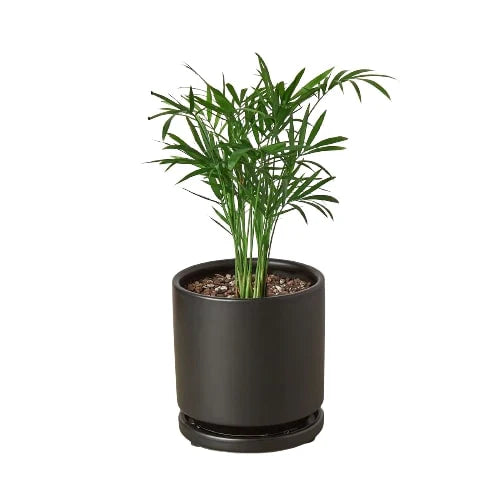
The Parlor Palm has been a fixture of indoor spaces since the Victorian era, when it earned its name by gracing the parlors of elegant homes that couldn't support larger tropical palms. It's been in continuous cultivation ever since — which tells you something about how well it adapts to indoor life. The soft, arching fronds and slender stems give it a refined, unhurried quality that feels timeless rather than dated.
Chamaedorea elegans is one of the most low-light tolerant palms available, which is why it's thrived indoors for over a century. It grows slowly and gracefully, never becoming unruly, and its compact footprint makes it suitable for spaces that can't accommodate larger trees. In brighter conditions it will grow faster and occasionally produce small yellow flower clusters — a quiet surprise that rewards a well-cared-for plant.
This is a palm that belongs indoors as much as anywhere.
Why You'll Love It
There's a reason the Parlor Palm has endured through every trend in interior design for over a hundred years. Its delicate fronds and elegant proportions complement almost any style — from Victorian to mid-century to contemporary minimalism — without looking out of place. It's a plant that has genuinely earned the word "classic."
Care at a Glance
Light: Low to bright indirect light. One of the most light-tolerant palms for indoor growing
Water: Allow the top inch of soil to dry between waterings. Avoid overwatering
Humidity: Appreciates moderate to high humidity but tolerates average indoor conditions
Temperature: Prefers 65 to 80 degrees F. Keep away from cold drafts
Growth: Slow to moderate. Rarely exceeds 4 feet indoors
Skill level: Beginner-friendly. Reliable and unfussy
Pet safety: Non-toxic to pets and humans
Good to Know
Brown leaf tips on a Parlor Palm are almost always caused by dry air or fluoride in tap water — both common in apartments and centrally heated homes. Switching to filtered water and adding a pebble tray makes a noticeable difference. Don't remove fronds that are still partially green — the plant draws nutrients from them until they're fully spent. Only trim fully brown, dry fronds at the base.